- All products
- EQUIPMENT
- AIR QUALITY
- VASTHI
- Ambient SO2 Gas Analyzer (CAAQMS)
- VASTHI
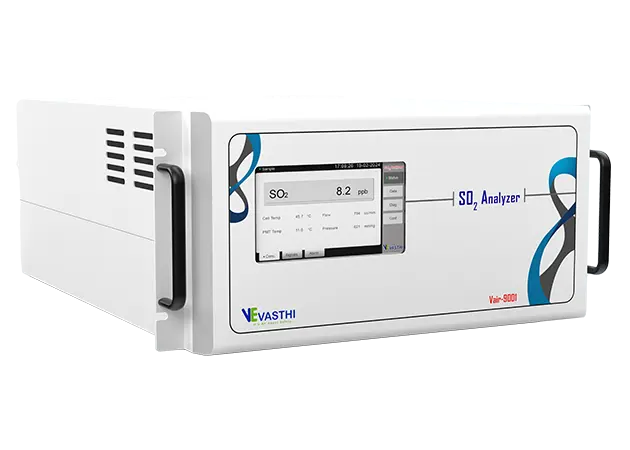
Ambient SO2 gas analyzer
Understanding ambient SO₂ gas analyzers: benefits, functionality, and applications
Introduction to ambient SO₂ gas analyzers
The Vair-9000 SO₂ analyzer accurately measures the minimum amount of SO₂ in the air using the UV fluorescence method. The UV lamp with the least sensitivity change used in the Vair-9001 was utilized, and a custom-made kicker was installed to eliminate components that obstruct the process, such as HC.
To prevent sample adhesion, the response chamber and sample tube were used with a special coating material to enhance minimum detection and accuracy.
All gas analyzers in the Vair series are equipped with a screen interface design that uses TFT-LCD and a touchscreen so that the user can operate the analyzer and maximize the visual image, and the MCU applied to the analyzer is a 32-bit ARM Cortex M4 processor that operates based on Linux Kernel 2.6, maximizing system stability due to multiprocessing.
Additionally, the analyzer is equipped with an automatic zero correction system (Auto Zero) for smooth measurement and various interfaces (Ethernet, RS232, RS485, USB, analog output) for the user to use it more conveniently and effectively.
What is sulfur dioxide (SO₂) and why monitor it?
Sulfur dioxide (SO₂) is a colorless gas with a pungent and penetrating odor, which is primarily released into the atmosphere through natural phenomena such as volcanic eruptions and anthropogenic sources, such as industrial emissions and the combustion of fossil fuels. Elevated levels of SO₂ can cause respiratory problems, environmental degradation, and the formation of acid rain, which harms ecosystems. Therefore, monitoring and controlling SO₂ emissions have become essential in urban planning, public health, and environmental protection.
How do ambient SO₂ gas analyzers work?
Ambient SO₂ gas analyzersuse advanced technologies to detect and quantify sulfur dioxide in the air. These devices typically use UV fluorescence, a method that takes advantage of the fluorescent properties of SO₂. The operation of this technology is detailed below:
- UV fluorescence method: When exposed to ultraviolet (UV) light, SO₂ molecules absorb energy and release it in the form of fluorescent light. The analyzer detects this fluorescence to calculate the concentration of SO₂ in the air, with the intensity of the light corresponding to the amount of SO₂ present.
- Electrochemical sensors: In some models, electrochemical sensors convert chemical reactions into electrical signals, allowing the device to determine SO₂ levels. This method is often cost-effective and compact, making it suitable for small-scale applications.
- Non-dispersive infrared (NDIR) sensors: Some analyzers also use NDIR technology, which involves measuring the absorption of infrared light by SO₂ molecules. The analyzer calculates the gas concentration by analyzing the absorbed wavelengths, although this method is more commonly used for other gases due to its higher cost.
- Each of these methods allows SO₂ gas analyzersto operate with high precision and responsiveness, ensuring reliable data for environmental monitoring.
Benefits of using an environmental SO₂ gas analyzer
Environmental SO₂ gas analyzers offer multiple benefits that contribute to air quality management, regulatory compliance, and public health. Here are the main advantages:
Real-time monitoring: Modern SO₂ analyzers provide real-time data, allowing for timely responses to pollution incidents and enabling regulatory authorities to take immediate action if levels exceed safe limits.
Data accuracy and reliability: Advanced analyzers offer high levels of accuracy, ensuring precise measurements even at low concentrations. This accuracy helps industries comply with air quality standards and avoid costly fines.
Cost-effectiveness in long-term monitoring: By continuously tracking SO₂ levels, environmental gas analyzers allow for long-term data collection without the need for frequent calibration or maintenance, reducing overall costs.
Protection of public health and the environment: monitoring SO₂ levels helps mitigate its adverse effects on respiratory health and prevents environmental damage caused by acid rain and soil acidification.
Key applications of environmental SO₂ gas analyzers
Environmental SO₂ gas analyzers are widely used across various sectors for their ability to track and control sulfur dioxide emissions. Below are some of their main applications:
Environmental Monitoring and Air Quality Stations: Governments and environmental agencies install environmental SO₂ analyzers at air quality monitoring stations to ensure that SO₂ levels remain within safe limits. These stations provide crucial data used to protect the population and inform policy decisions.
Industrial Emissions Monitoring: Industries that produce sulfur dioxide, such as power plants, oil refineries, and chemical plants, use SO₂ gas analyzers to monitor and control emissions. By complying with regulatory limits, these industries help minimize their impact on air quality.
Health and Safety in the Workplace: In workplaces where exposure to SO₂ is a risk, such as chemical manufacturing and mining operations, environmental SO₂ analyzers help maintain safe working conditions by continuously measuring air quality to protect employees.
Transportation Emissions Control: Vehicles, particularly those that use diesel, contribute to SO₂ emissions. Environmental SO₂ analyzers can be used in areas with heavy traffic to monitor emissions and guide policies aimed at reducing pollution levels in urban environments.
Research and Environmental Studies:Environmental researchers and scientists use SO₂ analyzers to study pollution patterns, monitor changes in air quality, and assess the long-term impact of SO₂ on ecosystems. The data from these studies inform strategies to combat pollution and protect biodiversity.
How to choose the right environmental SO₂ gas analyzer
The selection of the appropriate SO₂ gas analyzer depends on several factors, such as the intended application, the required sensitivity, and the operating environment. When choosing an analyzer, consider the following:
Detection range and sensitivity: In areas with low SO₂ concentrations, analyzers with high sensitivity are essential for detecting small changes. Conversely, in industrial environments with higher levels of SO₂, a device with a wider detection range may be required.
Environmental conditions: Some analyzers are designed to withstand adverse weather conditions, making them suitable for outdoor applications. Others are more suitable for controlled indoor environments.
Easy calibration and maintenance: Low-maintenance analyzers reduce operational costs over time. Look for models that offer simple calibration processes to ensure consistent performance.
Data Connectivity: Advanced models often come with options for remote data transmission and storage, allowing for continuous monitoring and easy integration into existing environmental management systems.
Future Trends in SO₂ Monitoring Technology
The demand for accurate SO₂ monitoring continues to grow, driving advancements in environmental gas analyzer technology. Some trends defining the future include:
Sensor Miniaturization: As sensor technology advances, we see smaller and more portable SO₂ analyzers, making it easier to monitor SO₂ levels in more locations at lower costs.
Integration with IoT:The Internet of Things (IoT) allows SO₂ analyzers to connect with other devices for seamless data transfer, real-time alerts, and integration into smart city infrastructures.
Enhanced Data Analysis: Advanced software analytics enable more detailed analysis of SO₂ data, providing insights into pollution trends, predicting emission patterns, and helping authorities develop proactive air quality measures.
Conclusion
Ambient SO₂ gas analyzers are essential tools in the ongoing efforts to maintain air quality and protect public health. By accurately measuring sulfur dioxide levels in real-time, these devices help industries, governments, and environmental organizations take meaningful action against pollution. Whether for industrial use, environmental monitoring, or research, the benefits and applications of SO₂ gas analyzers highlight their value in promoting a cleaner and healthier environment for all.
FEATURES:
- Ranges 0-0.1 / 0.5 / 1 ppm, user-selectable.
- 7-inch touch screen and TFT LCD interface.
- Ethernet, RS-232, RS-485, and USB ports.
- The USB interface is used for downloading stored data.
- Temperature and pressure compensation and internal zero (optional)
- The built-in data logger uses NAND-Flash to store up to 1 year (average data of 1 minute)
| Measurement elements | Sulfur dioxide (SO₂) in ambient air |
| Model number | Vair - 9001 |
| Measurement method | Ultraviolet fluorescence (UVF) method |
| Ranges | 0-0.1/0-0.5/0-1 ppm (selectable) |
| Lower detectable limit | Less than 0.5 ppb |
| Repeatability | with ±1% reference gas concentration |
| Zero drift | Less than 2 ppb |
| Span drift | with ±1% full scale (1 day) |
| Response time (95%) | Less than 90 seconds (T95) |
| Linearity | with ±1% full scale |
| Accuracy | 0.5% of reading or 1 ppb |
| Operating temperature | 5 - 40 °C |
| Analog output | 0-1 V / 0-5 V or 4-20 mA (optional) |
| Sample flow | Flow control stabilized at 800 cc/min ± 10% of critical orifice |
| Particle filter | 47 mm Teflon filter |
| Display | 7-inch graphic LCD |
| Connectivity | Ethernet, USB 2.0, RS-232, RS-485 |
| Internal data memory | Measurement data (1 min/1 year), operation history, messages, alerts |
| Power requirement | 110-140 V, 50/60 Hz |
What is the operating principle of the ambient SO₂ gas analyzer?
The ambient SO₂ gas analyzer operates using UV fluorescence technology for accurate and continuous measurement of sulfur dioxide (SO₂).
What parameter does this SO₂ analyzer measure?
This analyzer measures the concentration of ambient sulfur dioxide (SO₂) for continuous monitoring of ambient air quality.
Is the ambient SO₂ gas analyzer suitable for continuous monitoring?
Yes. The system is designed for continuous and real-time monitoring of SO₂ in environmental and industrial settings.
Does this SO₂ gas analyzer comply with CPCB standards?
Yes. The ambient SO₂ gas analyzer is designed to meet regulatory air quality monitoring guidelines and CPCB standards.
Can the ambient SO₂ gas analyzer be installed outdoors?
Yes. The analyzer is housed in a weatherproof cabinet, making it suitable for outdoor ambient air quality monitoring installations.